Scalable, high-quality planning
Coordinate large teams under tight runtime limits while balancing solution quality, computational cost, and theoretical guarantees.
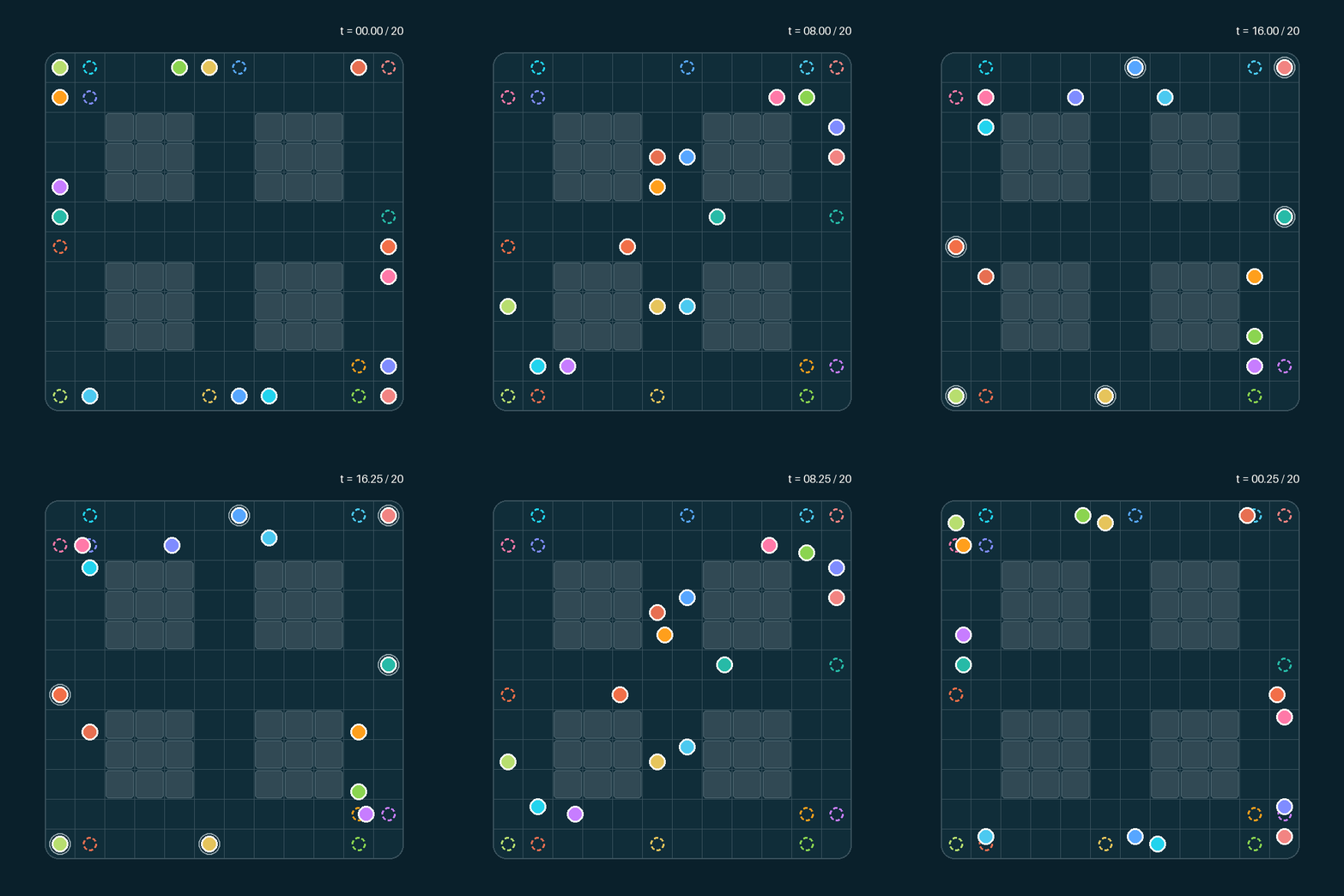
Multi-Agent Path Finding (MAPF) studies how to compute collision-free paths or trajectories for multiple agents from their start locations to assigned goals. It underpins warehouse automation, logistics, autonomous transport, service robotics, manufacturing, and large-scale fleet coordination. Despite its simple formulation, MAPF remains computationally challenging: minimizing sum of costs or makespan is NP-hard in common settings, while practical systems demand high-quality solutions under strict planning and execution constraints.
MAPF research now spans AI planning, heuristic search, robotics, machine learning, theoretical computer science, operations research, and multi-agent systems. Methods range from search and optimization to decentralized, learning-guided, and hybrid approaches, addressing lifelong planning, task allocation, scheduling, and execution. Uncertainty, dynamic environments, and robot-specific constraints continue to challenge these methods, highlighting the need for interdisciplinary discussion on the gap between MAPF research and deployed systems.
The eighth WoMAPF at AAAI-27 brings together researchers and practitioners to advance MAPF and related planning, routing, scheduling, and execution problems. Through invited talks, contributed presentations, posters, demonstrations, and community discussion, participants will exchange ideas and identify open problems. A key feature is an industry panel connecting research with practice in robotics, automation, logistics, and applied multi-agent systems, helping shape future directions for scalable and practical multi-agent coordination.
Coordinate large teams under tight runtime limits while balancing solution quality, computational cost, and theoretical guarantees.
Integrate path finding with task allocation, scheduling, and replanning under uncertainty, delays, communication limits, and robot-specific constraints.
Develop realistic benchmarks and system demonstrations that connect algorithmic advances with the requirements of deployed multi-robot systems.
Find submission, notification, registration, camera-ready, and workshop dates here.
Check Call for Papers for more details.
Abstract to be announced.